
Hyperfixation Nonfiction is About to Become Your Whole Personality
Everyone's reading about salt. Here are 17 more books that are just as niche and satisfyingly obsessive.
If you’ve signed on to any bookish corner of the internet lately, you’ve probably noticed that Salt by Mark Kurlansky is having a moment.
Kurlansky’s history of the mineral has gone wildly viral 20 years after it first came out. I could not be more delighted, because I read it in 2007 and have been trying to recommend this exact kind of book to people ever since. I like to call it hyperfixation nonfiction.
How does this made-up genre work? Someone picks one ordinary thing–salt, a fish, the color red, the moon–and gets so thoroughly obsessed that they write hundreds of pages about it. Paradoxically, the narrower they go, the bigger the story gets. You start with a spice and end up telling the whole history of human civilization. Just like salt, no literary diet is quite complete without this genre adding a little flavor.
Every book below is built upon that same passion, focused on a different topic, starting with the king of the category and moving to topics you never even realized needed their own book.
Heads up: you’ll notice a loooot of Mark Kurlansky on this list. I honestly could have made this whole list using just his books. He’s the undisputed master of the genre!
Paid subscribers get the subscriber-only posts and the paid sections you can’t read anywhere else, plus printables, the full archive, and a seat in every private reading challenge I run. That’s less than a dollar a week when you sign up annually!
My Top Picks
The six I’ve actually read and can’t shut up about. These are the ones that friends and family members begged me to stop sharing fun facts from, but I regret nothing.
A note on links: I am a library-first reader to my core, but I also love a good hardcover. If you want to support indie bookstores and my work, consider buying the ones you fall for through the affiliate links in this post. Thank you!
Salt by Mark Kurlansky
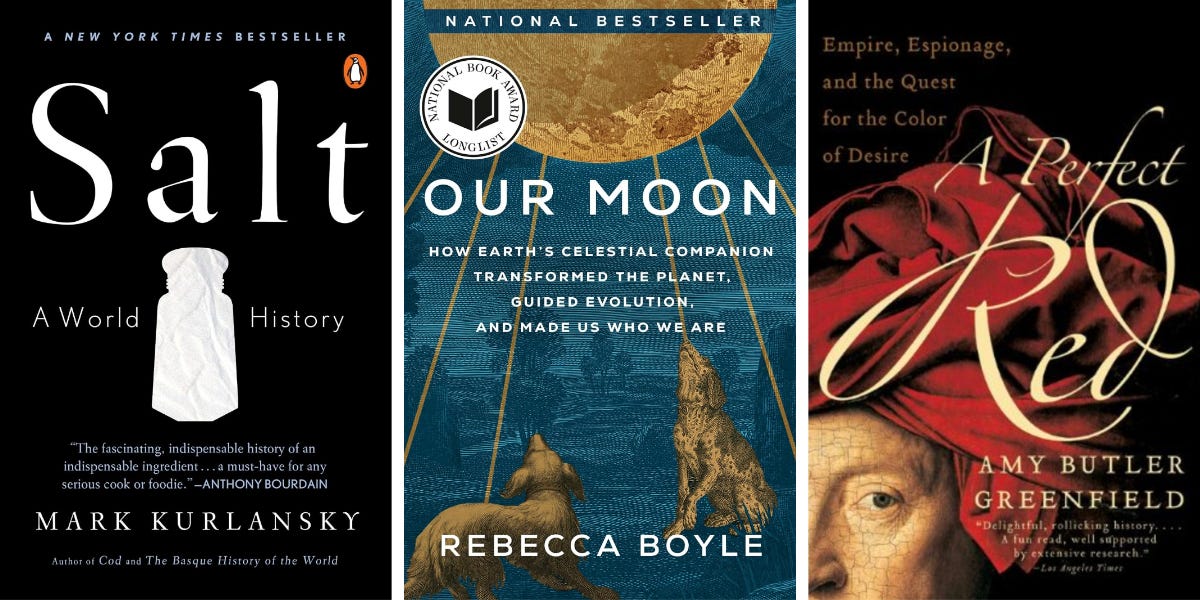
You kind of have to start here! Kurlansky follows a single seasoning from ancient Chinese salt works to Gandhi’s march to the sea, showing how the stuff in your shaker started wars, funded empires, and laid down the first roads and cities.
I read this back in 2007, and it permanently changed the way I look at my pantry shelf. Watching it go viral two decades later and seeing others discover the joy of a good nonfiction deep dive is so satisfying.
Our Moon by Rebecca Boyle
Our Moon takes the object you have looked at your entire life and shows how completely it made you who you are today. From Mesopotamian priests recording its phases and inventing science in the process, to Kepler, to Apollo, and to the billionaires now racing to mine it, Boyle argues the moon shaped our biology, our calendars, and our sense of who we are.
I’ve been obsessed with the moon for as long as I can remember. I love reading about it, tracking how it moves seasonally over a new landscape when moving to a new home, and planning my travel around certain phases of the moon (stargazing trips require new moons, whereas beach trips always benefit from lustrous full moons).
The moon smells like gunpowder, for the record!
A Perfect Red by Amy Butler Greenfield
Greenfield tells the story of cochineal, the intense red dye made from crushed insects in the New World. Behind this simple pigment are centuries of smuggling, espionage, and an empire that grew up around Spain’s fierce monopoly on it. Just to stoke your curiosity: whole nations sent spies chasing the secret of a single color, and you will be shocked once you find out just how complex it is to dye something red.
I loved this book. It is a heist, an economic history, and a deep dive into one color all at once. Considering how prevalent dyes and colorings are in our everyday life, you’ll forever see the world around you in a different light after reading this!
Silk by Aarathi Prasad
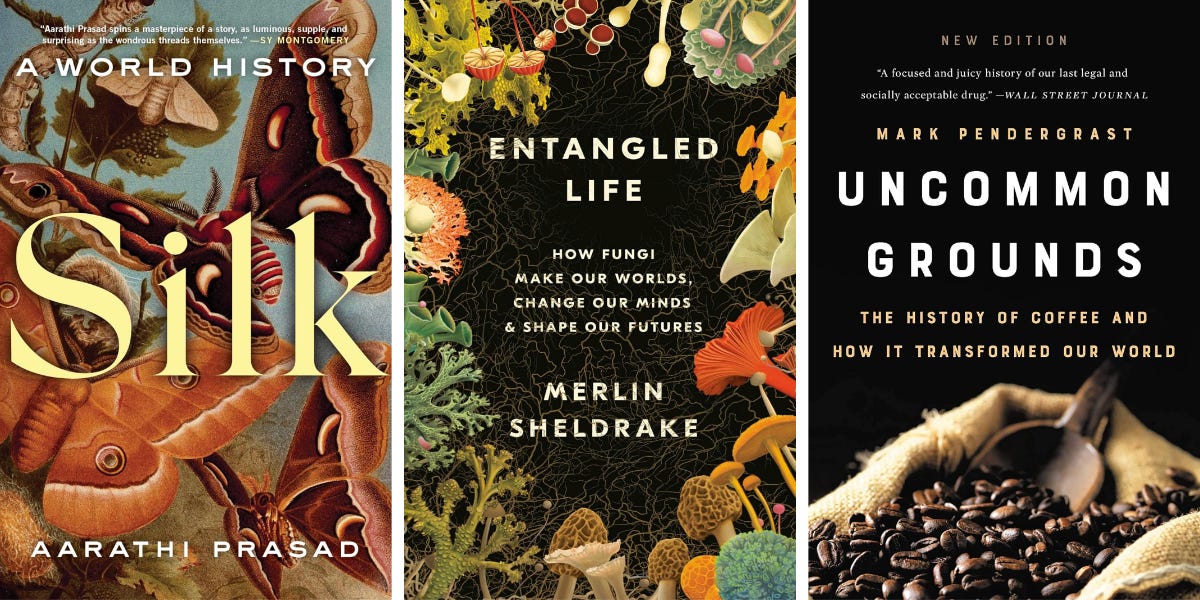
Prasad walks past the familiar silkworm and finds a far stranger story waiting: spiders farmed for thread, mussels that spin fibers underwater, and the overlooked scientists who tried to turn all of it into everything from body armor to surgical sutures.
It is the most surprising book in the batch, and the cover is lovely enough to leave face-up on the coffee table as bait for guests (or Substack readers if you’ve been on my feed recently 😉). I am currently about halfway through this book and am loving it so far.
Entangled Life by Merlin Sheldrake
This book will rearrange your sense of the world more than anything else here. Sheldrake follows fungi from the mold in your refrigerator to the mile-wide networks feeding entire forests underground, and argues that the organisms we pay the least attention to are the ones actually running the place.
When I tell you I think about this book all the time... We do not realize how much of the world is made up of fungi and how much mold might actually be running the show. Sheldrake was so devoted to his subject that he let oyster mushrooms grow out of a printed copy of his own book and then ate them. If that is not the entire spirit of this list, I do not know what is!!!
Uncommon Grounds by Mark Pendergrast
There is a very high chance you are holding a cup of coffee at this very moment! Pendergrast carries coffee from the hills of Ethiopia through colonial plantations and Brazilian fortunes to the rise of Starbucks, stopping along the way in the coffeehouses where more than one revolution got its start.
It is long, but I promise that it earns every page. Once you read it, you won’t be able to believe you knew so little about something that’s such a big part of your day. I read this back in 2005, and still think about it frequently!
What’s on My Holds List
Do I have a hyperfixation tag on Libby? Yes, I do! These are the books that I am currently waiting for my turn to read. Well, there are actually about 50, so I chose the ones I’m most pining to read. (If you want a part 2 with more of my obsessions, let me know in the comments).
Cod by Mark Kurlansky
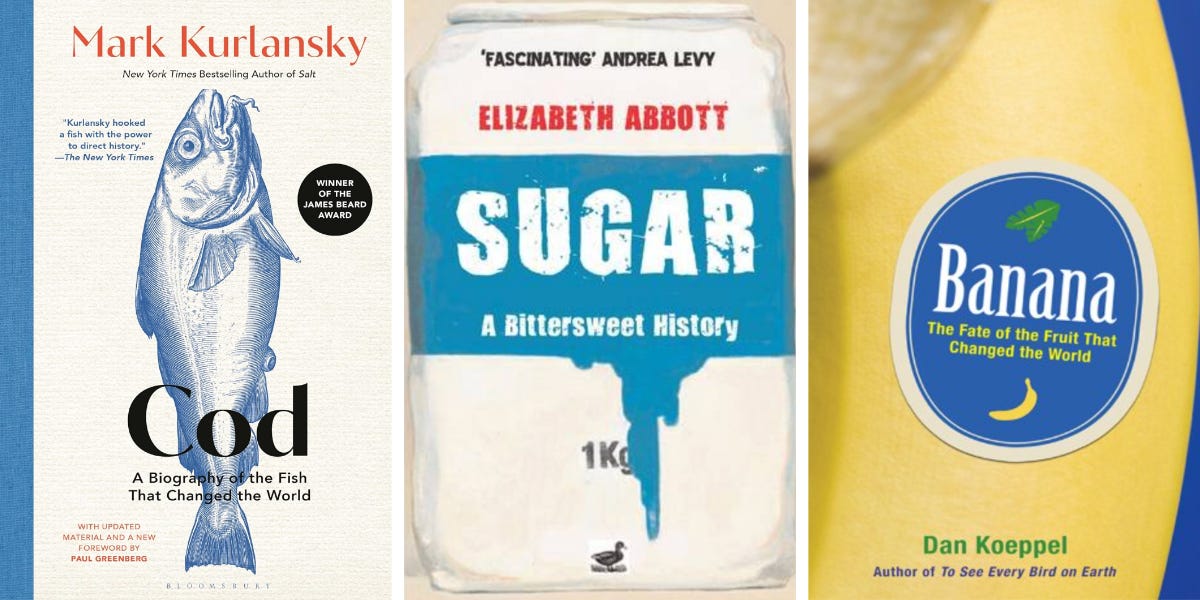
Cod is the fish that fed Europe for centuries, pulled explorers across the Atlantic, and built the economy of the New World before most people could find it on a map. Kurlansky follows cod from the Basque fishermen who guarded its waters to the collapse of the Grand Banks in the 1990s, when a fish that once seemed endless simply ran out.
Written by the same author as Salt, this book honestly looks just as good. As someone living in Brazil, where seasonal bacalhau makes grocery stores smell like fish markets around Easter each year, I need to read this book!
Sugar by Elizabeth Abbott
Few topics on this list cast a longer shadow… Sugar built plantations, powered the transatlantic slave trade, and bent whole economies around a craving the human body was never designed to satisfy. What begins as a simple sweet becomes one of the darkest engines of the modern world.
I’ve read quite a few historical fiction books that take place on sugar plantations but have never read a deep-dive into the commodity itself. I can imagine this is the kind of book that turns your world upside down.
Banana by Dan Koeppel
The most popular fruit on earth, and a genuinely alarming story once you get into it. Koeppel traces the banana from the jungles of Southeast Asia to the American corporations that toppled Central American governments to keep it cheap, then lands the real gut-punch: the banana in your kitchen is a fragile clone, and a single fungus is working its way toward wiping it out.
I listened to a podcast on disappearing bananas a while back and found it fascinating. So, when my best friend said her dad wouldn’t shut up about “the Banana Book” all weekend, I knew my TBR had just grown one book longer.
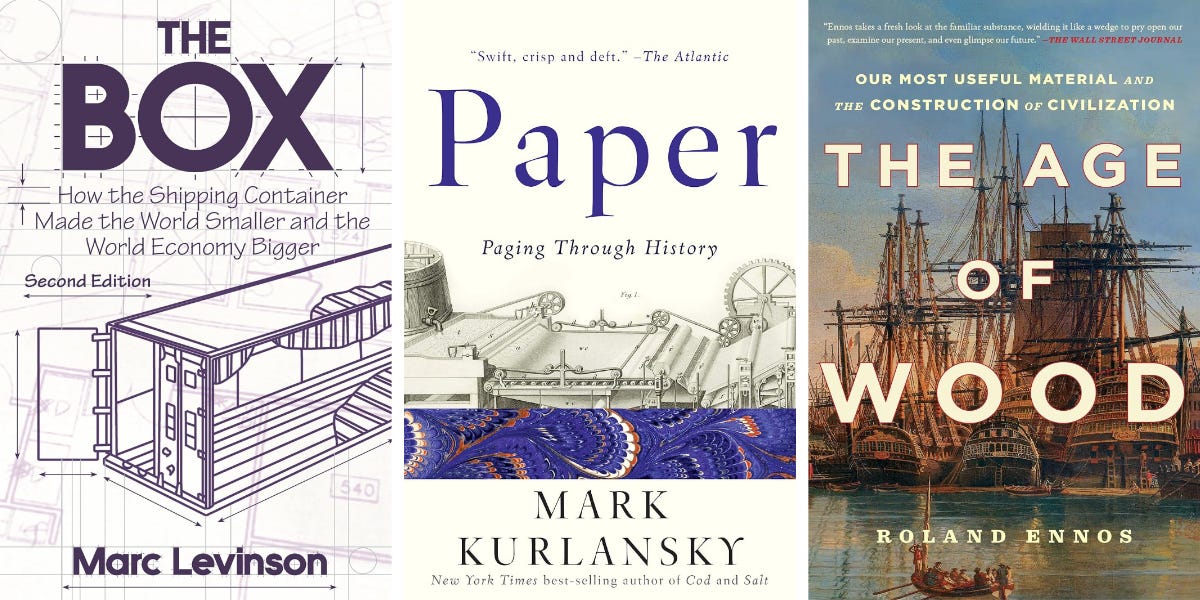
The Box by Marc Levinson
This is possibly the most world-altering object on this list. It’s definitely the dullest! Levinson tells the story of the humble shipping container, the plain corrugated box a stubborn trucking magnate invented in the 1950s. The result? Whole port cities that had thrived for centuries were hollowed out, and dockworkers lost their jobs by the thousands. It also paved the way for the cheap, international transfer of goods that has come to dominate modern life.
I did not expect to want to read an entire book about a metal box, and yet here we are. That reaction is pretty much why this post exists.
Paper by Mark Kurlansky
Kurlansky again, surprise, surprise! This time, he tracks paper’s slow travel from China through the Islamic world into Europe, building to an argument that stays with you: new technology does not create societies; societies reach for the technology they already need.
You wouldn’t guess it from the title, but this is said to be the most philosophical of Kurlansky’s commodity books (and, weirdly, the one most likely to start an argument at the dinner table).
The Age of Wood by Roland Ennos
Stone, bronze, iron. We have named all of human history after the hard stuff. Ennos thinks that’s backwards. His case is that wood did the real work the entire time, starting with the trees our ancestors climbed down from and running straight through to the spears, the houses, the ships, and the charcoal fires that smelted every metal those flashier ages got named for.
Books that reframe history through something this ordinary are exactly my catnip, so I have high hopes for this one.
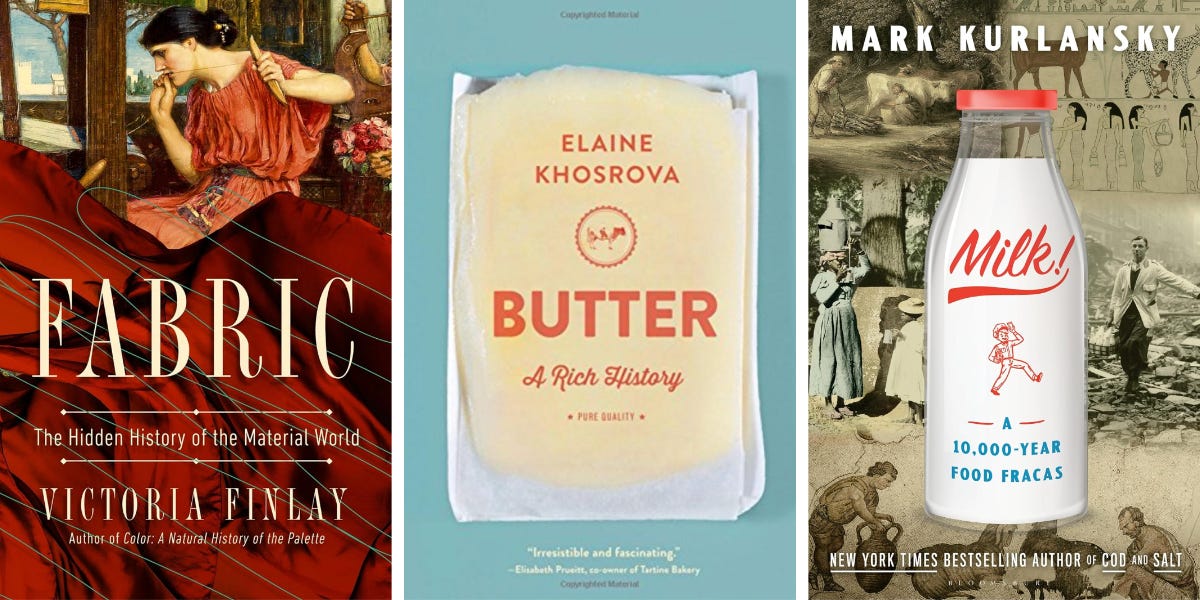
Fabric by Victoria Finlay
Finlay is a master of weaving together history and travel. Fabric deals with the history behind the cloth we spend our whole lives living in, weaving in stories of linen, cotton, wool, silk, and the synthetics that changed everything. This book treats each fiber as a doorway into a place and its past.
Where Color (more info below!) is about what we see, this is about what we touch all day without noticing. I recently started watching a YouTube channel, where a woman is growing, spinning, and weaving her own dress out of flax. She’s already over a year into the process, and she still doesn’t have a dress. Videos like that and books like this one truly reshape our view of just how lucky we are to have such easy access to things like clothing in our modern world.
Butter by Elaine Khosrova
A full cultural history of the stuff you spread on your morning toast without a second thought. Khosrova travels from Himalayan yak butter to Irish bogs and folds in recipes so you can taste your way through her argument.
Butter is practically sacred in my family! It’s on my short-list of favorite foods, and I have strong opinions about it. So, when I found this book while researching this post, I could not BELIEVE that there was a book on butter, and I hadn’t read it. I’m rectifying that as soon as my hold comes in! 🧈
Milk by Mark Kurlansky
The fourth and final Kurlansky here, Milk tells the story of humanity’s oldest and most quarrelsome food. 10,000 years of milk, from the first herders to modern raw-milk standoffs, with recipes and a startling amount of conflict to boot.
If you have made it through his other three, this closes the set nicely. Kurlansky is prolific, yet the books that most called out to me (except for Paper) just so happen to be about food-related items. He’s a masterful storyteller, though, so I can imagine any of his other books must be pretty good, food or no food!
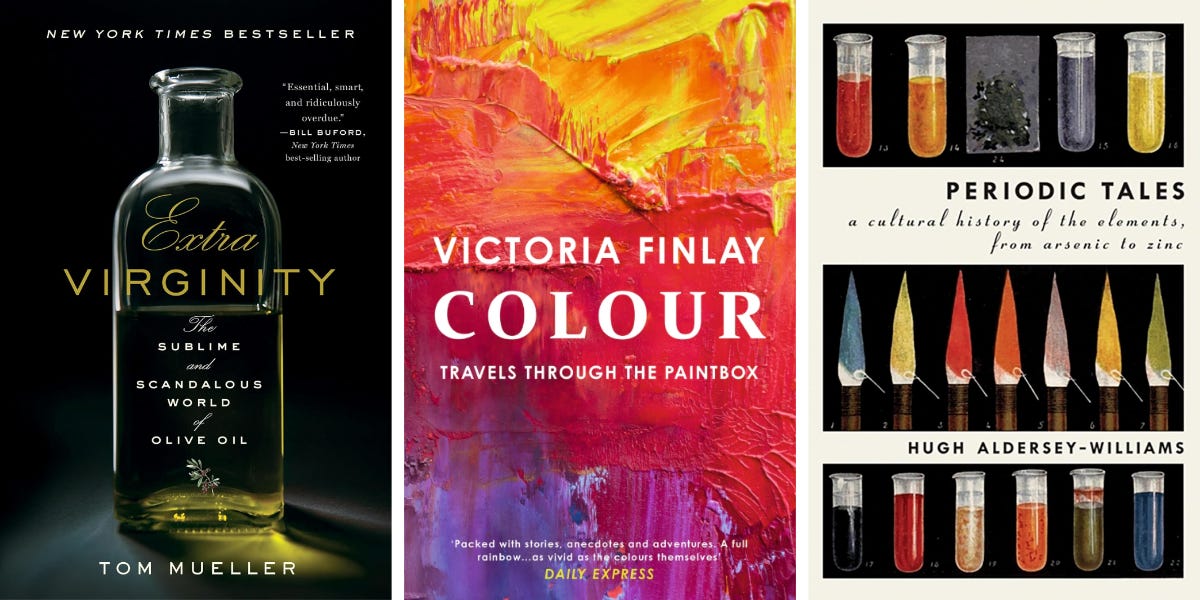
Extra Virginity by Tom Mueller
Start here if you want a book to ruin your next trip to the grocery store… You can’t say I didn’t warn you! Mueller pulls apart the world of olive oil and reveals that a huge share of what gets labeled “extra virgin” is watered down, blended, or outright faked, part of a scam running from ancient times straight through modern supply chains.
There is real detective energy to this book, villains and busts and all. I have a feeling that you will come out the other side reading oil labels like a suspicious cop.
Color by Victoria Finlay
In Color, Finlay travels the world chasing the origins of pigments, and the journeys turn out to be as good as the colors themselves. She climbs to the Afghan mountains where lapis lazuli became a blue once worth more than gold, visits the cochineal behind red (which you already know all about if you read A Perfect Red…), and hunts down the strange sources of ochre, indigo, and mummy brown.
If A Perfect Red left you wanting more, this is the natural next step. Instead of one color, it promises the whole rainbow, and everyone who’s read it seems to come away unable to look at a painting the same way.
Periodic Tales by Hugh Aldersey-Williams
This is for all you fellow science nerds out there. Periodic Tales is the history of the periodic table reimagined as a cabinet of human stories. Aldersey-Williams goes element by element through the gold that drives greed, the phosphorus first boiled out of buckets of urine, the iron sitting in both your blood and your buildings, and the obsessives who chased each one down.
Periodic Tales takes the driest chart you remember from school and turns it into a shelf of adventure stories. Whoever said science is boring clearly hasn’t been reading books like this!
Obsession Is Contagious
Here is what I love about every book on this list. The object is the whole point. It has been sitting right there on your counter, becoming so familiar that you stopped seeing it years ago. Then, someone comes along who is obsessed enough to show you the entire universe that simple object contains.
Nothing on this list is exotic. What’s astonishing, after reading these types of books, is realizing just how much you realize you never knew about the things we take for granted every day. How the story of the world can be told through a single grain of salt.
Now I’d love to hear about your favorite hyperfixation books.
I know there is a perfect book out there I have not found yet, some gloriously obsessive history of buttons or concrete or hangers, and I want you to be the one who tips me off!
I love this genre! I read Everything is Tuberculosis by John Green earlier this year and I think it could qualify as a hyper-fixation read. I remember telling my mom I was reading this one and then launched into a whole list of “fun” facts about tuberculosis. She looked at me like I was crazy.
I second Mary Roach as one of the best in this genre. Stiff was amazing. Would love to see a Part 2 from you on this